
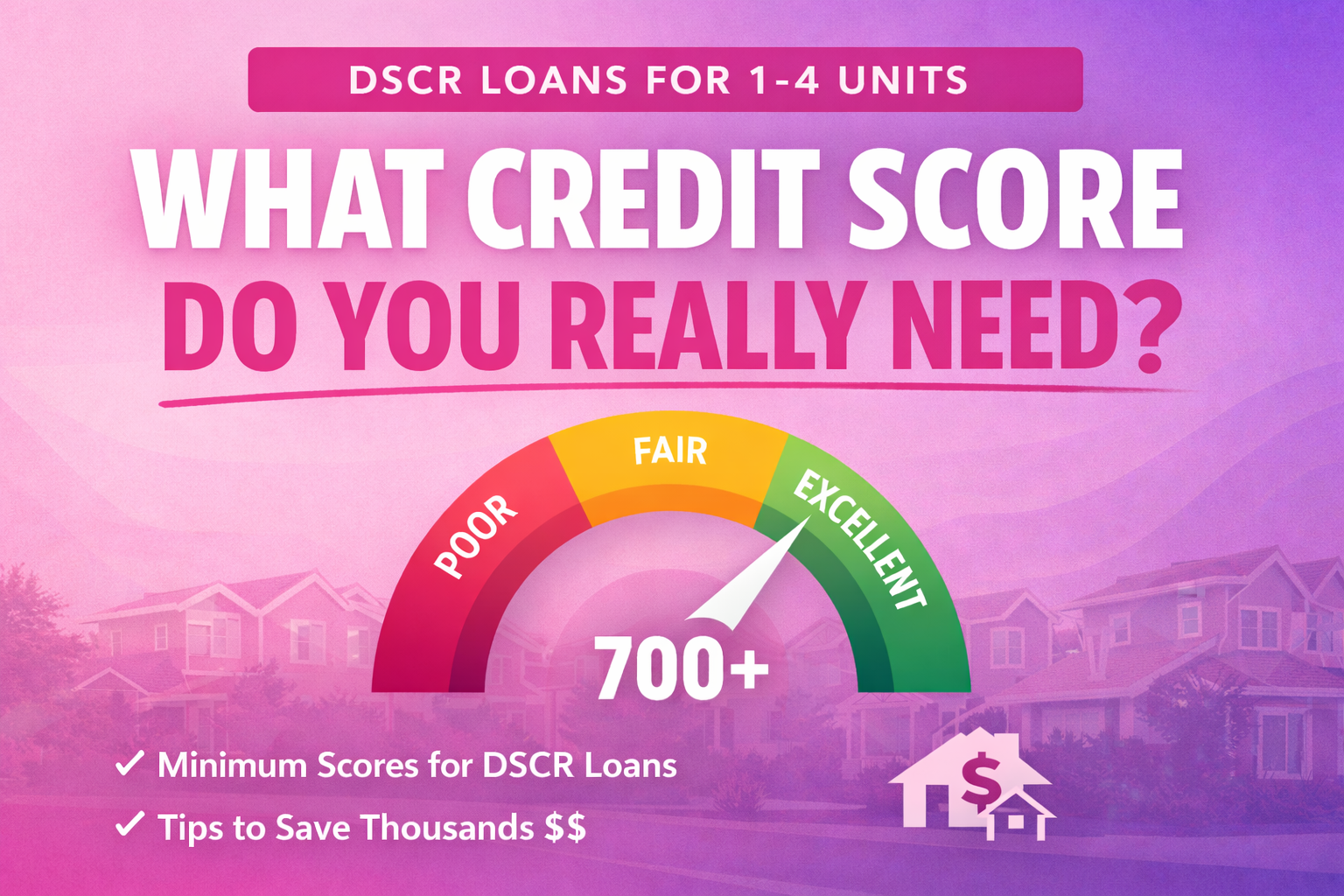
The real minimum credit score for a DSCR loan
Most DSCR lenders fall into a minimum range of about 620 to 680, depending on the lender, your LTV, DSCR, reserves, and overall file strength.
Here’s the simplest way to think about it:
- 620 is possible with some DSCR programs, usually with tighter leverage or pricing.
- 660 is a common minimum on many DSCR matrices.
- 680 is a very common “mainstream” minimum, especially with larger DSCR lenders.
- If you want noticeably better pricing, 700+ is often the turning point.
What I tell investors to plan around
- If you want the widest lender options, plan for 680+.
- If you are 620 to 679, you can still close, but structure matters way more.
- If you want the best shot at great pricing, aim for 700+.
- If you are at 699, it’s worth trying to jump to 700 if it’s realistic.
Credit score brackets (and why 699 is not “basically 700”)
DSCR pricing is usually tiered. That means a single point can bump you into a better bucket.
Credit score bracket table
| Credit score bracket | What this often means for DSCR | Quick move if you’re stuck |
| 640 to 659 | Possible, but fewer options and tighter leverage | Lower LTV, show stronger reserves |
| 660 to 679 | More lenders open up, pricing still not best | Aim for 70% LTV, consider longer prepay |
| 680 to 699 | Common “eligible” tier, but still not top pricing | If you’re at 699, try to jump to 700 |
| 700 to 719 | Often a real pricing improvement | Keep LTV clean and DSCR strong |
| 720 to 739 | Strong tier | Compare lenders and structures |
| 740 to 759 | Premium tier | Optimize points vs rate |
| 760 to 779 | Top tier for many grids | Don’t over leverage if cash flow is tight |
| 780+ | Excellent tier | Pick the best scenario |
Real example: how 1 point can cost about $4,000 on a $350,000 rental
Let’s assume:
- Purchase price: $350,000
- DSCR purchase loan
- 75% LTV
- Loan amount: $350,000 x 0.75 = $262,500
The “699 vs 700” cost math
If the pricing difference between tiers is about 1.50 points, then the cost swing can look like this:
- $262,500 x 1.50% = $3,937.50
- That’s basically $4,000
Quick takeaway bullets:
- Being one point short can be expensive
- Bracket jumps matter more than small score increases inside a bracket
- If you cannot jump brackets, change your structure
How lenders actually use your score
Some lenders may let you use the strongest borrower’s credit when there are multiple applicants.
Pro tip: This can unlock better pricing. If your score is lower, you can also bring in a qualified partner with stronger credit to help you land better terms.
If you can’t improve your credit score fast, use these 3 levers instead
These are the three most effective ways to save thousands even if your score stays the same.
Important note: the savings below are estimates using points as the “cost” so you can compare apples to apples. Real pricing varies by lender and day.
Savings table: $350,000 purchase example
Assumptions:
- Base loan: 75% LTV = $262,500
- Costs shown are rough “pricing improvement” examples in points
| Lever | What you change | Why it works | Example savings |
| Lower LTV | 75% to 70% | Less risk for the lender | About $3,000 |
| Longer prepayment penalty | 3-year to 5-year | More lender certainty, often better pricing | About $2,000 |
| Rate term instead of cash out | Cash out refi to rate term refi | Cash out often prices worse | About $3,000 |
Now let’s break each one down with simple bullets and math.
Lever 1: Lower your LTV (75% to 70%)
This is the fastest “instant upgrade” move.
What it looks like
- 75% LTV loan amount: $262,500
- 70% LTV loan amount: $350,000 x 0.70 = $245,000
Why it saves money
Lower leverage usually improves pricing because the lender has less risk.
Example savings math
If dropping from 75% to 70% improves pricing by about 1.20 points:
- $245,000 x 1.20% = $2,940
- About $3,000 saved
Bullet summary:
- Most predictable lever
- Works even when credit is stuck
- Requires more cash down
Lever 2: Choose a longer prepayment penalty (3-year to 5-year)
This is a clean trade in DSCR.
You give the lender more certainty.
In return, you often get better pricing.
Example savings math
If the 5-year option improves pricing by about 0.75 points:
- $262,500 x 0.75% = $1,968.75
- About $2,000 saved
Bullets to decide fast:
- If you will hold 5+ years, consider it
- If you might sell or refinance soon, do not trap yourself
Lever 3: Rate term refinance instead of cash out (when it fits)
Cash out pricing is often worse than rate term pricing. Also, cash out can come with tighter leverage rules.
The big mistake
Paying cash out pricing just to walk away with a small amount of cash.
The practical rule
If you only need a small amount of cash, do not pay cash out pricing to get it. Keep it rate term.
How to decide if cash out is worth it
If choosing cash out costs you about $3,000 more in pricing, I want you to net meaningfully more than that.
Rule of thumb:
- Only choose cash out if you can pull at least $15,000+ in usable cash
- If you are only netting a few thousand, rate term is usually the cleaner deal
Quick example:
- Extra cost: about $3,000
- If you only get $2,000 to $5,000, it is usually a bad trade
- If you get $10,000+, it can be worth it depending on your goal
Quick cheat sheet (save money fast)
If your score is stuck:
- First try: lower LTV from 75% to 70%
- Then try: longer prepay if you are a long term holder
- Then check: rate term instead of cash out if you do not need real cash
Common mistakes I see
- Thinking 699 is basically 700
- Shopping lenders before you lock the structure (LTV, prepay, loan purpose)
- Picking cash out automatically
- Not asking how the lender prices multiple borrowers
Quick FAQ
Can I get a DSCR loan at 640?
Sometimes yes, but you should expect more restrictions and higher cost.
Do most DSCR lenders want 680?
Many do. It is one of the most common “mainstream” minimums.
Is 700+ a real pricing jump?
Often yes. Many pricing grids have a clear tier improvement at 700.
Is the $2,000 cash back rule always true?
Rules vary by program. Some programs cap cash back on certain refinance types, so confirm based on the exact lender and exact loan type.
If you’re looking to purchase or refinance your rental property, contact me at dahae@roamingevergreen.com or 571-363-5589 and say “DSCR”.
I’ll tell you the one lever that will save you the most money first.
Follow Dahae Yi on Instagram @dahaeyi.lender — Hard Money & DSCR Lending Tips
About the Author
Dahae Yi is a commercial loan broker and real estate funding educator specializing in fix and flip and rental financing. She teaches investors how to structure lender ready deals, avoid expensive financing mistakes, and scale from their first property to a real portfolio with confidence.







Leave a Reply