
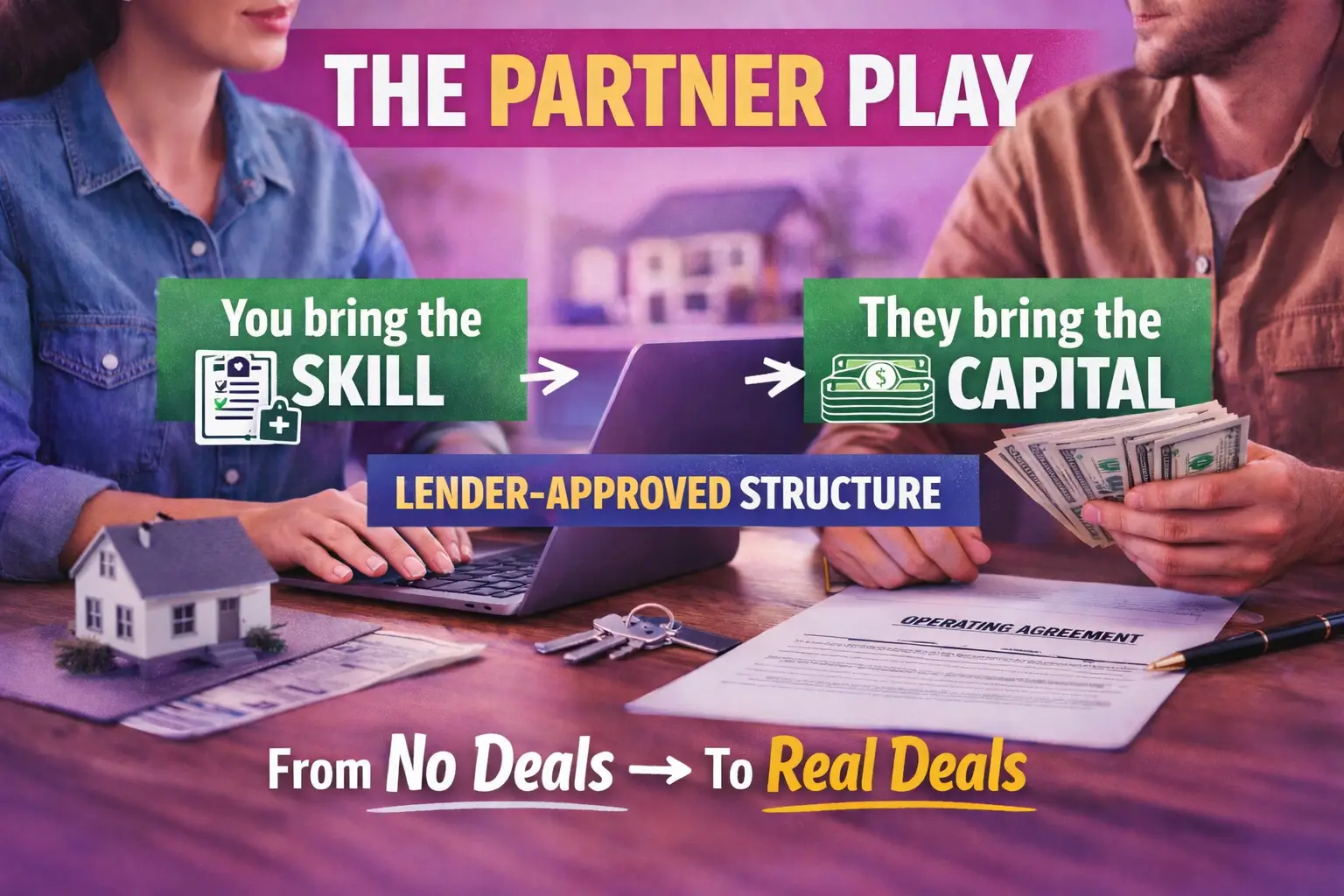
If you already know how to find deals, manage rehabs, or run rentals, lack of cash is usually not the real problem.
Structure is.
This is where the partner play comes in.
When one person has experience and time, and someone else has money, lenders already know how to approve this. The key is setting it up the right way.
Short answer
An experienced investor can buy rental properties without using their own money by partnering with someone who brings the capital. The deal is structured through an LLC with clear ownership percentages and a written operating agreement. Depending on the structure, the money partner may not need to personally guarantee the loan.
Why this works
Lenders care about three main things:
• Who is running the deal
• Who owns the property
• Who is responsible for the loan
They do not require every partner to play the same role.
That flexibility is what allows this strategy to work.
The simple version explained like a 5 year old
One person knows how to build the Lego house.
Another person owns the Lego blocks.
They agree to build together.
They decide how to share it.
They write the rules down.
That’s it.
Who this strategy is best for
This works especially well if you:
• Already have deal experience
• Know how to manage rehabs or rentals
• Can find deals but feel stuck saving cash
• Want to scale faster than your savings allow
If you have no experience at all, lenders usually want more guardrails in place. This strategy shines when one partner is clearly the operator.
Common partnership structures lenders approve
Here are the two most common ways this is set up.
Option 1: Create a new LLC together
Both partners form a brand new LLC.
• Both are members of the LLC
• Ownership is split however you agree
• The LLC buys the property
This is clean and simple, especially for first deals together.
Option 2: Add the money partner to an existing LLC
If you already have an LLC with experience:
• The money partner is added as a member
• Ownership percentages are updated
• The existing LLC buys the property
This can be powerful if the LLC already has a track record.
Ownership vs loan responsibility
This is where most people get confused.
Ownership and loan guaranty are not the same thing.
Here’s a simple table.
| Role | What it means |
| Owner | Has equity in the LLC |
| Guarantor | Personally responsible for the loan |
| Capital partner | Contributes cash |
| Operating partner | Runs the deal |
Depending on the lender and ownership split, the money partner may:
• Be an owner
• Not be a guarantor
• Have no involvement in day-to-day operations
This is decided upfront, not guessed later.
Example ownership splits
There is no standard split. It depends on risk and contribution.
Common examples:
• 50/50 when both bring cash and experience
• 70/30 when one runs everything and one funds
• 80/20 when capital is passive and protected
The number matters less than clarity.
Why the operating agreement is non-negotiable
Partnerships fail when expectations are not written down.
A proper operating agreement should clearly define:
• Ownership percentages
• Who makes decisions on what
• Who manages the property
• How profits are split
• How someone exits the partnership
• What ifs and resolutions
How this turns impossible deals into real deals
Here’s what usually happens without this structure:
• Good deal found
• Not enough cash
• Deal passes
• Someone else buys it
With the partner play:
• Experience attracts capital
• Capital unlocks the deal
• Structure keeps everyone protected
That is how some investors go from zero to multiple properties in a short time.
Common mistakes to avoid
These mistakes cause most partnership problems.
• No written operating agreement
• Unclear profit split
• Mixing personal and LLC money
• Assuming the money partner must be on the loan
• Not discussing exit plans early
Avoiding these makes lenders more comfortable too.
Lender-ready partnership checklist
Before talking to a lender, have this ready:
• LLC formed or updated
• Ownership percentages agreed
• Operating agreement drafted
• Clear roles defined
This makes underwriting smoother and faster.
FAQ
Can the money partner stay completely passive?
Yes, if the structure allows it and the lender approves.
Does the money partner have to guarantee the loan?
Not always. It depends on ownership percentage and lender rules.
Can this work for first-time rentals?
Yes, especially if the operating partner has experience.
Is this legal?
Yes. This is standard business structuring when done correctly.
What matters most to lenders?
Clear structure, clear responsibility, and a strong exit plan.
Final thoughts
Most people think money is what’s holding them back.
In reality, it’s usually structure.
If you already know how to run deals, the partner play can be the bridge between where you are and where you want to go.
Follow Dahae Yi on Instagram @dahaeyi.lender – Hard Money & DSCR Lending Tips
About the Author
Dahae Yi is a commercial mortgage lender and real estate funding educator specializing in fix and flip and rental financing. She helps investors structure lender-ready deals, avoid common funding mistakes, and scale faster through the right mix of capital, strategy, and structure.





Leave a Reply