
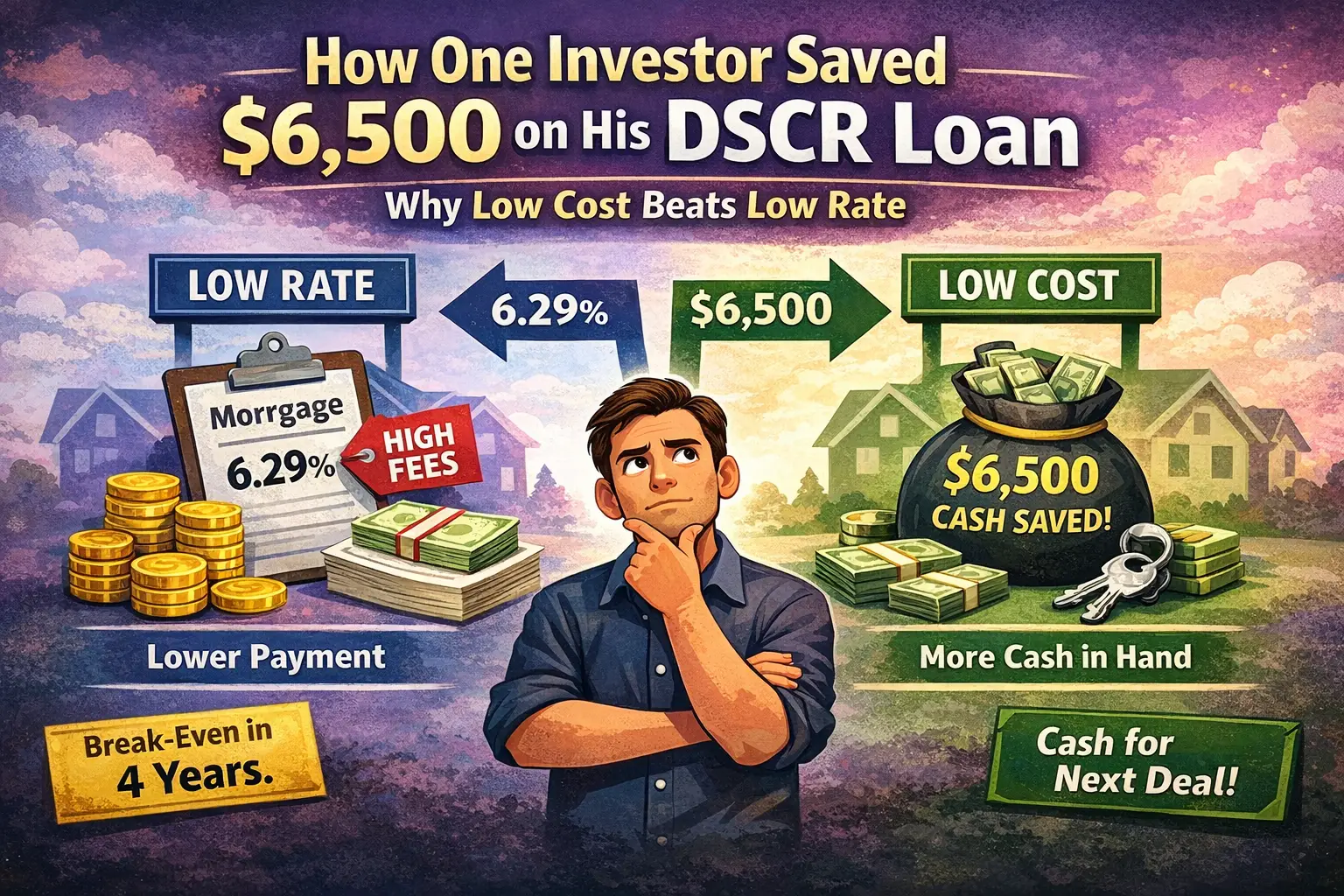
When comparing DSCR loan options, most investors focus only on getting the lowest interest rate. But upfront costs matter more than you think. One investor saved $6,500 by choosing a higher rate with lower upfront costs. The lower rate option would have saved him only $135 per month, taking over 4 years to break even. For investors actively scaling their portfolios, keeping cash now often beats marginally lower monthly payments.
Key Facts: Low Rate vs Low Cost
| Factor | Low Rate Option | Low Cost Option |
| Upfront Cost | $6,500 higher | $6,500 lower |
| Monthly Savings | $135 more | $135 less |
| Break-Even Period | 48 months (4 years) | Immediate cash advantage |
| Best For | Long-term hold, no scaling plans | Active investors, deal flow focus |
| Cash Available | Tied up in fees | Available for next deal |
How to Evaluate DSCR Loan Options in 3 Steps
Most investors never see both options clearly laid out. Here’s how to compare them properly.
Step 1: Get Both Quotes Side by Side
Ask your lender for two full scenarios. One with the lowest rate they can offer. One with the lowest upfront cost. Make them show you all the numbers.
Step 2: Calculate Your Break-Even Point
Take the difference in upfront costs. Divide it by your monthly payment savings. This tells you how many months it takes to recover that upfront cost.
Formula: Upfront Cost Difference ÷ Monthly Payment Difference = Break-Even Months
Step 3: Consider Your Investment Timeline
If you’re planning to hold the property past your break-even point, the lower rate might make sense. If you’re actively buying more properties, you probably need that cash now more than you need slightly lower payments later.
Real Example: How This Investor Made the Decision
One of my investors was buying a duplex. He had two DSCR loan options on the table.
Purchase price: $330,000 Loan amount: $264,000
Option A – Low Rate:
- Rate: 6.29%
- Monthly payment: $1,633
- Upfront costs: $6,500 more
Option B – Low Cost:
- Rate: 7.06%
- Monthly payment: $1,768
- Upfront costs: $6,500 less
Most people would have jumped on Option A. Lower rate sounds better, right?
He ran the math instead.
Upfront cost difference: $6,500 Monthly payment difference: $1,768 – $1,633 = $135 Break-even: $6,500 ÷ $135 = 48 months
That’s 4 years before he would start seeing any real benefit from that lower rate.
He had another deal ready to go. He chose Option B, kept the $6,500, and used it toward his next property down payment.
Understanding the Numbers Behind DSCR Loans
DSCR loans work differently than regular mortgages. Lenders look at the property’s cash flow, not your personal income.
What DSCR Means
DSCR stands for Debt Service Coverage Ratio. It measures whether your property makes enough rent to cover the mortgage payment.
Formula: Monthly Rent ÷ Monthly Mortgage Payment = DSCR
Most lenders want to see at least 1.0 DSCR. Some prefer 1.25.
How Rates and Costs Connect
Lenders can adjust your deal in different ways. They can give you a lower rate but charge more upfront. Or they can reduce upfront costs but charge a slightly higher rate.
Think of it like buying discount points in reverse. You’re either paying now or paying over time.
Why Upfront Costs Add Up
Upfront costs on investment property loans include:
- Origination fees (usually 1-2% of loan amount)
- Rate buy down fees
- Processing fees
- Underwriting fees
- Appraisal
- Title work
- Closing costs
On a $250,000 loan, a 2-point difference in origination alone is $5,000.
Common Mistakes Investors Make with DSCR Loans
Mistake 1: Only Looking at Rate
Rate matters. But it’s not the only thing that matters. Upfront costs, prepayment penalties, term length, and funding speed all affect your real cost.
Mistake 2: Not Calculating Break-Even
You can’t know which option is better without doing the math. Most investors guess. Don’t guess.
Mistake 3: Ignoring Your Current Cash Position
If you have $20,000 in reserves and three deals in your pipeline, paying an extra $6,500 upfront might leave you too thin. If you have $200,000 sitting idle, the calculation changes.
Mistake 4: Forgetting About Opportunity Cost
That $6,500 sitting with the lender isn’t earning you anything. That same $6,500 in your next deal could be earning equity and cash flow within months.
Mistake 5: Not Asking for Both Options
Many lenders only show you one option. They assume you want the lowest rate. Ask them to show you the full range. Low rate, low cost, and maybe one in between.
Mistake 6: Choosing Based on What Sounds Good
Lower rate sounds better than higher rate. But sounding better and being better are two different things. Run the actual numbers for your situation.
Your Lender-Ready DSCR Loan Checklist
When you talk to lenders about DSCR loans, bring these items:
- Property address and basic details
- Purchase price or current value
- Expected monthly rent (with comps to back it up)
- Monthly tax, insurance, and HOA if applicable
- Target loan amount
- How much cash you have available
- Your timeline for closing
The more prepared you are, the better options your lender can show you.
Frequently Asked Questions
What is a DSCR loan?
A DSCR loan is a type of investment property financing that qualifies you based on the property’s rental income instead of your personal income. Lenders calculate your DSCR by dividing the monthly rent by the monthly mortgage payment. Most lenders require at least 1.0 DSCR, meaning the rent covers the payment.
How do I know if I should choose low rate or low cost?
Calculate your break-even point. Divide the upfront cost difference by the monthly payment difference. If you plan to hold the property longer than your break-even period, the lower rate might make sense. If you’re actively buying more properties or need cash for other deals, the lower upfront cost often wins.
Can I negotiate DSCR loan terms?
Yes. Most lenders offer multiple pricing options. You can often adjust the rate, points, and fees to find the structure that works best for your situation. Always ask to see at least two scenarios before deciding.
How long does it take to close a DSCR loan?
Most DSCR loans close in 30 to 45 days. Some lenders can move faster if you have all your documents ready.
Do I need perfect credit for a DSCR loan?
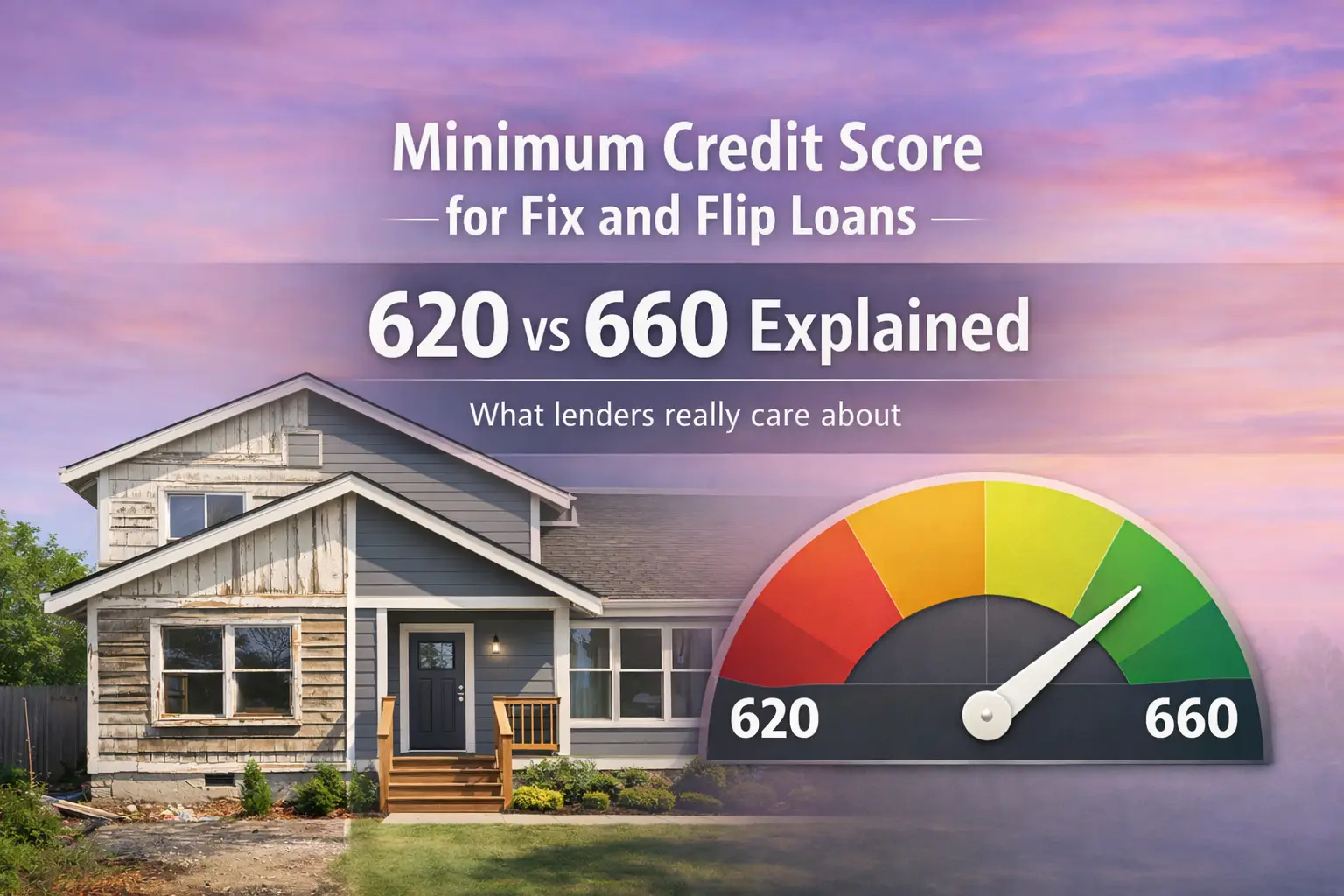
No. Most DSCR lenders accept credit scores as low as 660. Your credit score affects your rate and terms, but DSCR loans are more flexible than conventional mortgages because they focus on the property’s numbers.
What’s the minimum down payment for a DSCR loan?
Most DSCR lenders require 20% to 25% down. On a $300,000 property, that’s $60,000 to $75,000.
Can I use a DSCR loan for a fix and flip?
DSCR loans work best for rental properties you plan to hold. For fix and flips, you want a short-term loan like hard money that funds your rehab as well as purchase price.
How does rent calculation work for DSCR loans?
Lenders use market rent. If your lease is higher than maker rent, some lenders will use up to 125% of market rent.
What happens if my DSCR is below 1.0?
Some lenders still approve loans below 1.0 DSCR, but you’ll pay a higher rate and need more money down.
Should I pay points to lower my DSCR loan rate?
Only if you’re planning to hold the property long enough to recover the cost. Use the same break-even calculation.
Glossary of Terms
DSCR (Debt Service Coverage Ratio): The ratio of monthly rent to monthly mortgage payment. Formula: Rent ÷ Payment. A DSCR of 1.25 means the rent is 25% higher than the payment.
LTV (Loan-to-Value): The percentage of the property value you’re borrowing. Formula: Loan Amount ÷ Property Value. An LTV of 80% means you’re borrowing 80% and putting 20% down.
ARV (After Repair Value): The estimated value of a property after renovations are complete. Used for BRRRR deals and fix-and-flips.
Points: Upfront fees charged by lenders, expressed as a percentage of the loan amount. One point equals 1% of the loan. Points can be used to buy down your rate or charged as an origination fee.
Break-Even Point: The number of months it takes to recover upfront costs through monthly payment savings. Formula: Cost Difference ÷ Monthly Savings.
Origination Fee: The fee a lender charges to process and fund your loan. Usually 1-3% of the loan amount.
No Ratio DSCR: A DSCR loan where the property’s debt service coverage ratio is below 1.0, meaning the rent doesn’t fully cover the payment. These loans come with higher rates.
Market Rent: The amount a property could reasonably rent for based on comparable properties in the area. DSCR lenders use market rent.
Prepayment Penalty: A fee charged if you pay off your loan early. Common on DSCR loans. Usually 5 or 3 years declining (3% first year, 2% second year, 1% third year).
BRRRR: Buy, Rehab, Rent, Refinance, Repeat. A real estate investment strategy where you buy a property below market value, fix it up, rent it out, refinance to pull your money back out, and use that cash to buy the next property.
Next Steps
If you’re actively working on rental property deals and want to understand your best DSCR loan options, I’m happy to walk through the numbers with you. I can show you both the low rate and low cost scenarios so you can see exactly what makes sense for your situation.
Book a time on my calendar and we’ll map out your options.
About the Author
Dahae Yi is a commercial lender and real estate funding educator specializing in fix & flip and BRRRR financing. She teaches investors how to structure lender-ready deals and offers flexible, relationship-based funding terms that improve as the partnership grows. Her content is designed to help investors scale faster, avoid common funding mistakes, and secure funding with confidence.Follow Dahae on Instagram: https://www.instagram.com/dahaeyi.lender




Leave a Reply