

You do not need to “wait a year” to earn better DSCR terms.
Most of the best improvements happen before underwriting even opens your file.
Because with DSCR loans, you are not just being approved as a borrower. Your deal is being approved as an income producing asset.
So if you want lower rates, higher leverage, fewer conditions, and a smoother close, the question becomes:
What can you upgrade about the deal itself?
Let’s walk through the highest impact levers investors use to earn better DSCR terms fast, including a form of “credit improvement” that has nothing to do with your credit score.
What lenders price DSCR terms on
Even though DSCR loans do not use your personal income the same way conventional does, lenders still price based on risk.
Here are the factors that typically move your pricing the most:
- DSCR ratio: stronger cash flow usually earns better pricing and approvals
- LTV: lower leverage usually earns better pricing
- Credit profile: not just your score, your overall profile
- Prepayment structure: longer prepayment penalty structure you have better the terms
- Property type: single family, condo, small multifamily, mixed use, short term, unique assets
That means your fastest “term upgrade” comes from improving cash flow, reducing perceived risk, and presenting the deal cleanly.
The DSCR term upgrade map
Here’s the simplest way to think about it.
Better terms usually come from one of these three upgrades:
- Income strategy changes that increase DSCR
- LTV optimization that moves you into a better pricing tier
- Prepayment penalty that gives lenders more confidence in length of the loan
You do not need all three. One strong move can change your term sheet.
The income strategy levers that change DSCR
If you want better DSCR pricing, increase the rent the lender can actually use.
That last word matters.
You can raise income in real life, but if underwriting cannot document it, it does not count.
Here are the highest impact income strategies investors use.
Use the strongest rent documentation available
Most DSCR lenders will use one of these:
- LTR: market rent from the rent comps
- LTR: signed lease amount or 125% of market rent whichever is lower
- STR: 75%-100% AirDNA projection (depending on your STR experience)
- STR: actual income avg. in the last 12 months
If your lease rent is higher than market rent, you need a signed lease by closing and you need a lender that will actually consider it.
Examples of income that can help when handled correctly:
- Corporate leases, with signed lease and acceptable to that lender
- Section 8, with signed lease and acceptable to that lender
- Mid term & Short term rentals, with AirDNA projections
The win is not “having higher rent.” The win is “having higher rent underwriting can use.”
Reduce expenses to raise DSCR
DSCR is basically income divided by housing payment.
If you cannot push rent higher, reduce expenses that drive the payment.
Targets that move the needle:
- Insurance: shop it early, especially in coastal, high wind, or older property scenarios
- Taxes: understand whether the county reassesses on sale and model the post close tax bill
- HOA: high HOA can break DSCR even when rent looks strong
- Rate buydowns or points: sometimes paying points improves DSCR by lowering interest rate and payment
- LTV: slightly lower LTV can reduce rate, which reduces payment, which improves DSCR
This is why “rate and LTV” are also income strategy levers. They change the payment side of DSCR.
LTV optimization that actually gets you better pricing
Most investors think LTV is simply “how much can I borrow.”
But in DSCR, LTV is also a pricing tier.
Moving from one LTV tier to the next can change rate, points, and approval flexibility.
Here are common ways investors optimize LTV without waiting a year.
Bring in just enough additional down payment to move tiers
Sometimes the best move is not a huge down payment.
It is a small move that gets you out of the highest risk tier.
For example, moving from 80 percent LTV to 75 percent LTV can open better pricing and reduce conditions with some lenders.
Create a stronger appraised value story
You cannot “force” an appraisal, but you can support it.
Before appraisal:
- Have a clean list of upgrades and improvements
- Provide rent comps if the property is a rental
- Provide a fully executed lease if you are using in place rent
- Make the property easy to access and easy to evaluate
Appraisals are not magic. They are documentation and comps.
How small tweaks can save tens of thousands
Let’s put numbers behind it.
Here is a simple example where the deal did not change much, but the structure did.
Assume:
- DSCR loan amount: $260,000 (74.3% of $350,000 property value)
- 30 year amortized payment comparison
- Holding period: 5 years
Small tweak: improve deal strength enough to move pricing from 7.5% to 6.62%, and reduce origination from 2 points to 1 point.
| Item | Higher cost terms | Improved terms | Difference |
| Interest rate | 7.5% | 6.625% | 0.07 higher DSCR -> Better rate |
| Prepayment penalty | 3 year | 5 year | Better rate, thousands in saving or cash out |
| Monthly principal and interest | $1,818 | $1,665 | $153 per month savings |
| 5 year payment savings | $9,189 saved ($153 × 60) |
That is why term upgrades matter.
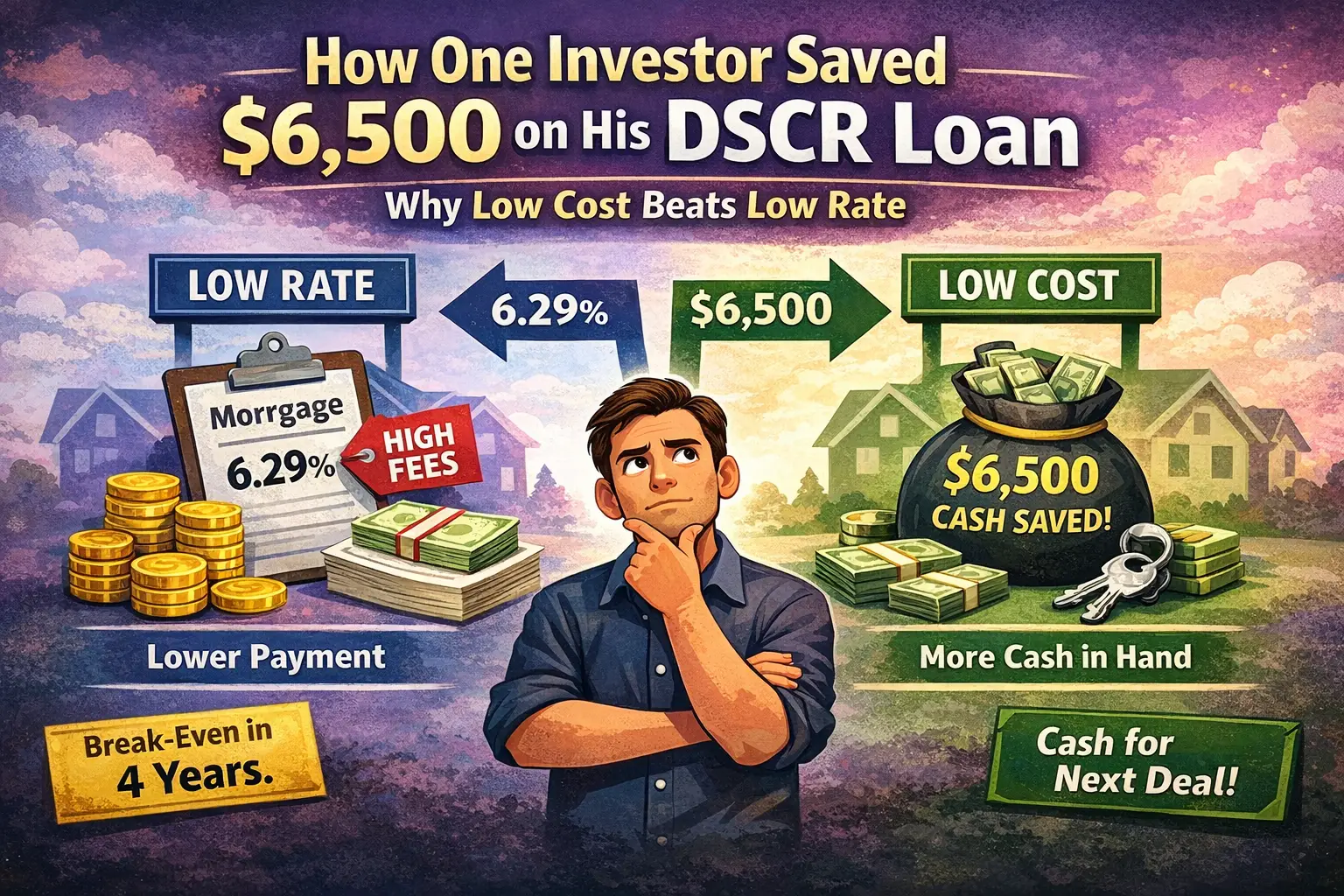
Most investors hunt for a better rate like it is a trophy.
The real win is the total cost of capital over your hold period.
Deal upgrade checklist before you submit to underwriting
Use this as your pre underwriting tune up.
Borrower strength
- Strong credit score. Pro tip: you can have a partner with a better credit score
- No surprise inquiries or new accounts right before closing
- Clean explanation for any major derogatories
- Clear liquidity for reserves and closing
Income strength
- Lease fully executed before closing
- If using corporate or Section 8, documentation is complete and clean
- Property expenses modeled realistically, especially taxes and insurance
File strength
- Entity documents ready and you must close in an LLC
- Bank statements clean and easy to trace (typically two to three months)
- Source of funds documented without confusion
- Insurance quotes started early
If you do this, underwriting becomes faster, conditions drop, and lenders are more willing to offer strong terms.
Steps to lock a DSCR rate the smart way
Rate locks are where investors accidentally lose leverage.
Here’s a clean way to do it.
- Get your scenario priced first: property type, estimated value, rent strategy, LTV target, and credit profile
- Choose the right DSCR product: long term rental, short term rental, interest only, prepay structure
- Submit a clean initial package: loan application, government ID or Visa, entity docs, bank statements, credit authorization
- Lock when your terms are final after underwriting
- Order appraisal and insurance immediately after lock to prevent delays
- Stay ahead of conditions: respond fast, keep documents consistent, avoid changing bank activity patterns
If you lock too early with a messy file, you risk re pricing, extra points, or a lock extension fee.
If you lock too late, you risk missing a rate window.
The goal is to lock when your deal is strong and your documentation supports it.
Quick scenarios and which lever to pull
| Your situation | Fastest lever | What to do next |
| DSCR is slightly low | Payment side | Try lower LTV, different prepay, points for rate reduction, or interest only option if available |
| Rent is strong but not “counting” | Documentation side | Use executed lease, pick lender that will use the right rent source, clean up the rent story |
| Credit score is fine but terms still bad | Credit profile | Lower utilization, reduce inquiries, show stronger reserves |
| Property type is unique | Product selection | Choose a lender and program that fits the asset, not a generic DSCR box |
| You want higher leverage | LTV optimization | Explore higher rent strategy, higher reserves, rent support, and appraisal story |
The easiest way to get better DSCR terms
Most investors try to negotiate a term sheet.
The better move is to make the deal undeniable.
When you improve the deal itself, lenders compete for it. And your terms get better without forcing a fight.
If you want, send me your deal basics and I will tell you the top one or two upgrades that would most likely improve your pricing.
Follow Dahae Yi on Instagram @dahaeyi.lender — Hard Money & DSCR Lending Tips
About the Author
Dahae Yi is a commercial loan broker and real estate funding educator specializing in fix and flip and rental financing. She helps investors structure lender ready deals, compare term sheets with confidence, and choose funding that supports both the flip today plan and the rent tomorrow plan. Her approach is relationship based and strategy first, focused on getting borrowers better terms by improving the deal, not just shopping the rate.








Leave a Reply