

The seasoning rule is one of the most expensive rules investors misunderstand when refinancing your fix and flip properties.
Not because it’s complicated, but because most people plan the deal first and find out about seasoning last.
When seasoning isn’t built into the timeline, the math gets ugly fast. Even a strong deal with a clean rehab and solid ARV can quietly bleed thousands in holding costs while waiting for a refinance window to open.
This blog breaks down what seasoning actually means for investors, why it exists, how poor planning eats into profit, and how to structure your flip or BRRRR timeline so seasoning works for you instead of against you.
What the seasoning rule actually means
Seasoning refers to how long you must own a property before a lender will allow a refinance based on the after repair value instead of your original cost basis.
For most investment property lenders, this means:
• 3 to 6 months of ownership before refinancing using ARV
• Shorter ownership uses cost basis, not ARV
• Longer ownership allows higher leverage on appraised value
Seasoning controls when you can unlock equity. It does not care how fast your rehab finishes.
Why seasoning exists
Seasoning rules exist to reduce lender risk.
Fraud prevention
Lenders want to see time, ownership, and completed improvements before recognizing a higher value.
Risk management
Time ownership shows stability. It confirms the rehab is complete, value is supported, and the borrower can manage the property beyond acquisition.
Seasoning is not something you avoid. It’s something you design around.
The hidden cost of poor seasoning planning
Every extra month you hold a finished property costs real money.
- Interest
- Taxes
- Insurance
- Utilities
- HOA fees
- Opportunity cost of trapped capital
Here is how fast that adds up.
Holding cost example
Loan amount: $300,000
Interest rate: 9 percent interest only
Monthly interest payment: $2,250
If poor planning adds 8 extra months of holding time:
$2,250 × 8 months = $18,000
That $18,000 did not improve the property.
It did not increase ARV.
It only paid for time.
How investors accidentally create this problem
This usually happens when rehab finishes too early.
Common mistakes include:
• Finishing rehab in 2 to 3 months with a 6 month seasoning requirement
• Not starting the refinance process until seasoning is fully complete
• Not accounting for appraisal and underwriting timelines
• Treating seasoning as a waiting period instead of renting it out
The calendar, not the deal, becomes the bottleneck.
Strategic timeline planning so seasoning works for you
The smartest investors plan their refinance timeline before they ever close on the purchase.
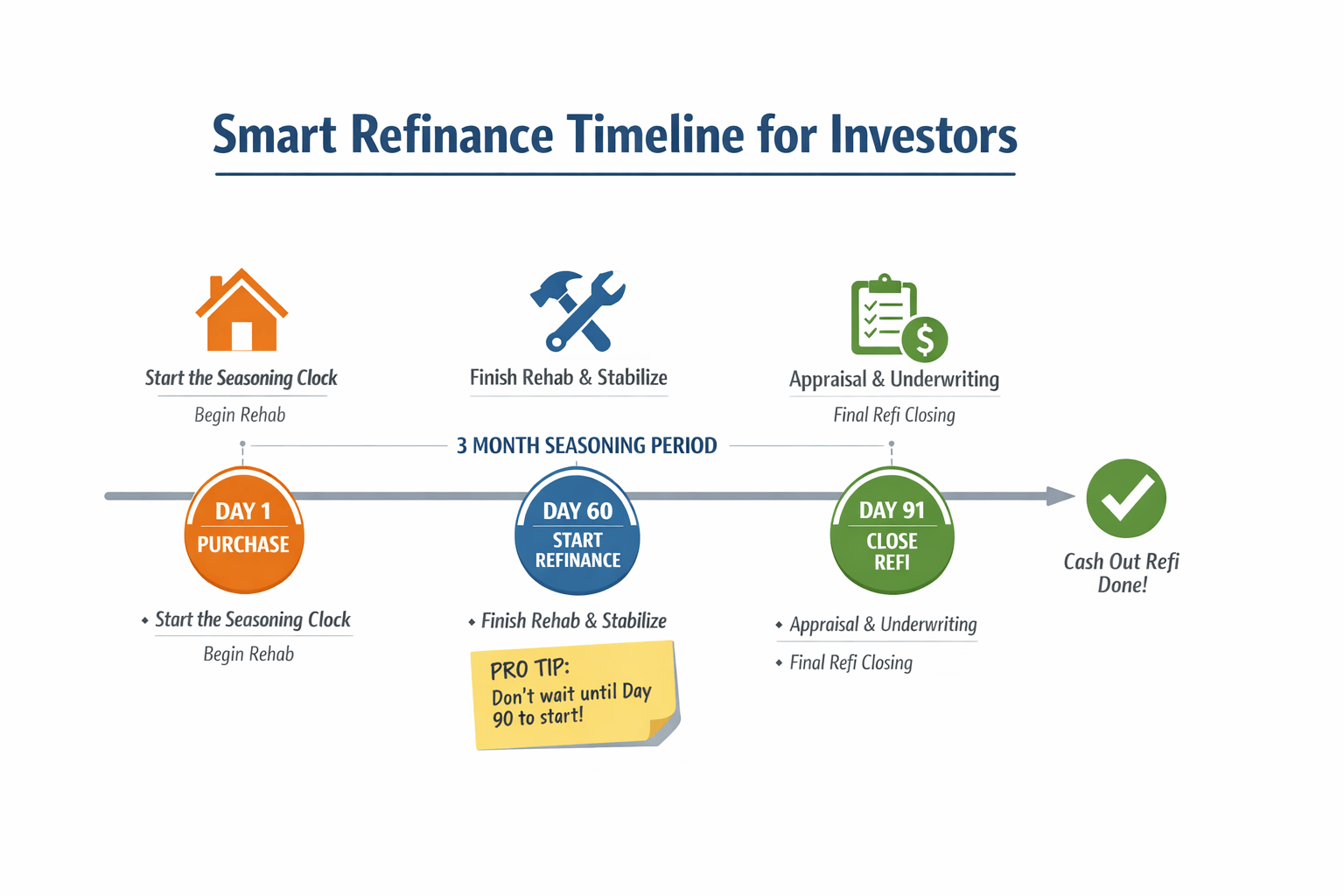
Here is what that looks like.
Purchase and close
Day one starts the seasoning clock. Not rehab start. Not lease up. Ownership.
Rehab phase
Plan rehab duration intentionally.
If your refinance requires 3 months seasoning, a 2 to 3 month rehab often aligns best.
Lease or stabilization
For rentals, lease immediately upon rehab completion.
DSCR lenders care about income stability and documentation.
Refinance process
Appraisal, underwriting, and closing usually take 30 to 45 days.
This process should overlap with the final stretch of seasoning, not begin after it.
The goal is to eliminate dead time.
BRRRR done right formula
BRRRR works when timing and financing are aligned.
Buy right
Purchase at a price that supports a refinance at 70 to 80 percent of ARV.
Rehab with proof
Track invoices, draw requests, and before and after photos.
Rent fast
Stabilize income immediately so DSCR works in your favor.
Refinance on schedule
Choose a lender whose seasoning rules match your rehab timeline.
Repeat efficiently
Capital velocity matters more than chasing the lowest rate.
Most BRRRR failures come from timing mistakes, not bad deals.
Why Seasoning Matters for DSCR Refinances
Seasoning directly impacts how much cash you can pull out.
Most lenders require seasoning. You can refinance but they may force you to use a lower value based on the purchase price and the rehab cost combined instead of ARV.
Same property.
Same renovation.
Very different outcome.
Typical Seasoning Rules You Will See With DSCR Loans
| Time Owned | Value Lenders Use | Typical Max LTV |
| Months 0–3 | Cost basis (purchase price + rehab costs) | Up to 70%-75% LTV |
| Month 4+ | Appraised value | Up to 70% LTV |
| Month 6+ | Appraised value | Up to 75–80% LTV |
Months 0-3: Lenders use cost basis (purchase price + rehab costs). 70%-75% loan to value
Month 4+: Lenders accept appraised value but leverage max. 70% loan to value
Month 6+: Lenders accept appraised value but leverage max. 75-80% loan to value
Seasoning guidelines can change often, confirm with your lender so you can plan accordingly.
LTV Comparison Based on Seasoning Timeline
Here is a simple example to show how seasoning can affect your refinance.
Purchase price: $200,000
Rehab cost: $50,000
After repair value: $330,000
| Time Owned | Value Used for Refi | Max LTV | Max Loan Amount |
| Month 1 | Cost basis (Purchase price + Rehab cost) | 70% | $175,000 |
| Month 3 | After repair value | 70% | $231,000 |
| Month 6+ | After repair value | 75–80% | $247,500 – $264,000 |
Same deal.
Same work.
Seasoning unlocks more equity.
The takeaway
Seasoning is not the enemy. Poor planning is.
If you treat seasoning as an afterthought, it quietly drains your profit. If you plan around it, it becomes a tool that unlocks equity efficiently and keeps your capital moving.
The difference between a smooth BRRRR and a frustrating one is rarely the property.
It’s the timeline and the numbers.
About the Author
Dahae Yi is a commercial loan broker and real estate funding educator specializing in fix and flip and rental financing. She helps investors structure lender ready deals across hard money, DSCR, and BRRRR strategies so they can scale faster with clarity and confidence. Her work focuses on aligning financing, timelines, and long term portfolio growth through practical education and real world lending experience.
Follow Dahae Yi on Instagram @dahaeyi.lender — Hard Money & DSCR Lending Tips










Leave a Reply