

The Short Answer
Most investors think hard money terms are non-negotiable. They are wrong. You can structure better terms by trading a slightly higher interest rate for lower origination fees, maximizing your loan to value to reduce cash at closing, and choosing lenders with fast draw processes that cut your holding costs. The difference between good terms and great terms can save you $5,000 to $15,000 per deal.
Step-by-Step: How to Negotiate Better Hard Money Terms
Step 1: Understand What You Can Actually Negotiate
Hard money lenders have flexibility in three main areas. They can adjust origination fees which are the upfront points you pay to get the loan. They can modify the loan to value percentage which determines how much cash you bring to closing. They can change their draw schedule and inspection process which affects how fast you get rehab funds.
You cannot negotiate interest rates down without giving something up. Lenders price risk. If you want a lower rate, expect to pay higher fees or bring more cash down.
Step 2: Trade Origination Fees for Interest Rate
Most investors negotiate backwards. They fight for the lowest interest rate possible and accept whatever fees the lender charges. This costs them thousands in upfront cash.
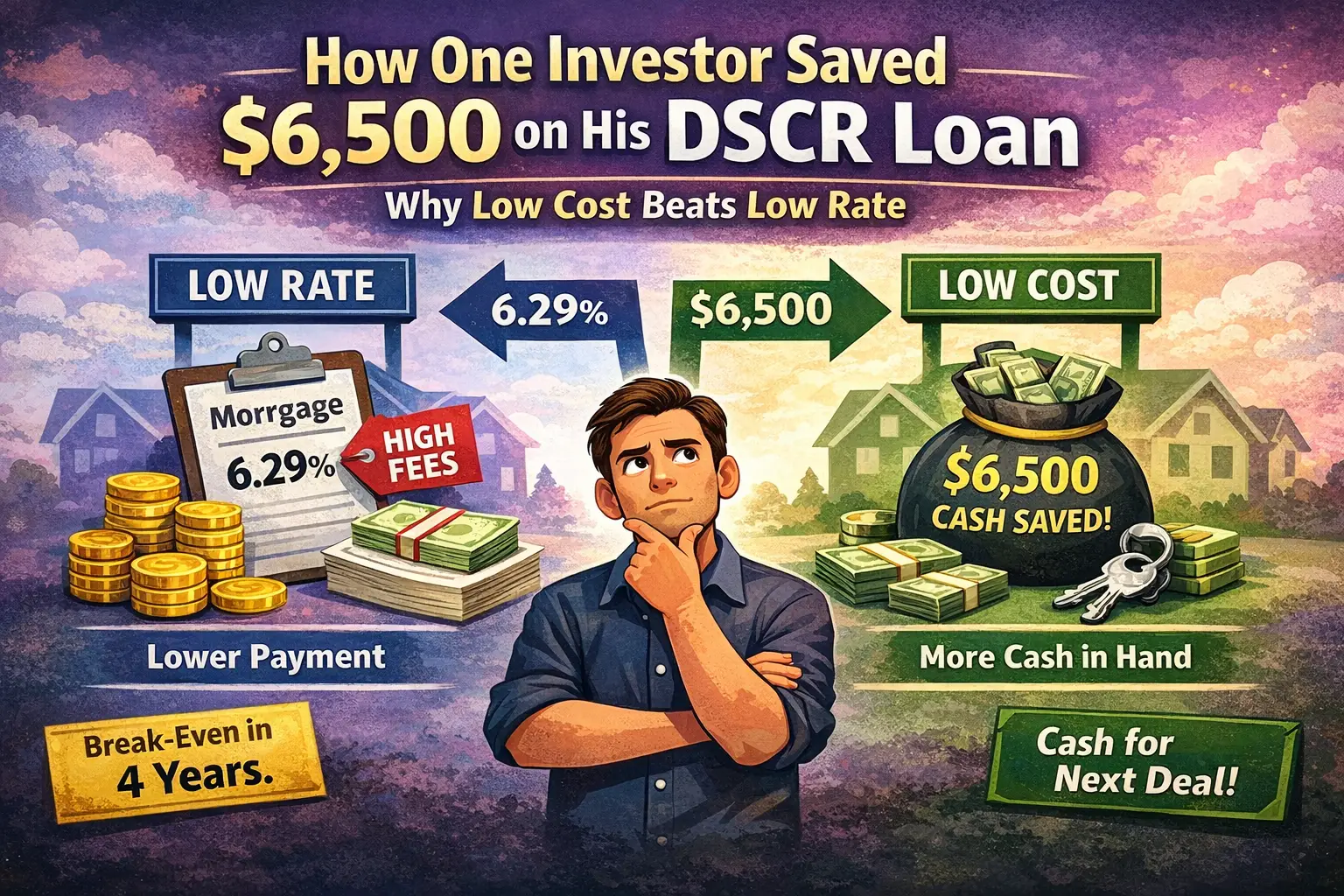
The smarter approach is to ask for reduced origination fees in exchange for a slightly higher interest rate.
Here is why this works. You only pay interest for the months you hold the loan. Most flips close in 4 to 6 months. But you pay origination fees in full at closing.
| Origination Fee | Interest Rate | Monthly Payment (Interest-Only on $300K) | Cash Needed at Close | Best For |
| 2 points ($6,000) | 10.00% | $2,500/month | ~$39,000 | Balanced option for most borrowers |
| 1.5 points ($4,500) | 11.00% | $2,750/month | ~$37,500 | Cash-limited borrowers who prefer lower upfront cost |
| 1 point ($3,000) | 12.00% | $3,000/month | ~$36,000 | Investors prioritizing minimal cash out at closing |
This table shows how investors can trade a higher interest rate for lower upfront costs when negotiating hard money terms.
Each 0.5–1% rate increase saves roughly $1,500–$3,000 at closing, but raises the monthly payment by about $250–$500 on a $300K loan.
It helps investors choose between paying more each month or keeping more cash available for rehab and holding costs.
Step 3: Maximize Your Loan to Cost Percentage
Standard hard money loans fund up to 80% to 90% of the purchase price. For 85% of a $200,000 purchase you bring $30,000 down to cover the total purchase price.
If you have a 720+ credit score, you’re likely to get up to 90 percent LTC with strong deals. This drops your down payment to $20,000.
The difference is $10,000 less cash needed at closing.
How to qualify for higher LTC. Show the lender 3+ completed flips, strong credit score of 720+, and liquidity beyond just the down payment.
Lenders give better terms to borrowers who reduce their risk.
Step 4: Investigate the Draw Process Before You Sign
The draw process is how you access your rehab funds during construction. Most investors ignore this until they are stuck waiting three weeks for their next payment while contractors sit idle.
Some lenders make this very easy by using mobile apps to submit required photos and invoices. Draw fees typically range between $250-$350 and can take anywhere from a couple days to several weeks.
Example on a 5 month flip with 4 draws:
Slow draw process: 4 inspections at $200 each equals $800 plus 3 extra weeks of holding costs per draw which is 12 weeks total delay times $2,000 per month equals $6,000 in extra carrying costs. Total added cost is $6,800.
Fast draw process: 4 draws, funds in 2 days, $300 fee, project finishes on time. Total added cost is $1,200.
The draw speed matters more than half a point on your interest rate.
Step 5: Run the Total Cost Comparison
Before you accept any hard money terms, calculate your total out of pocket cost including origination fees, interest based on your projected timeline, inspection fees, and the cost of delays from slow draws.
The loan with the lowest interest rate is rarely the cheapest option.
Deal Example: How You Can Save $14,000 Upfront Costs by Negotiating Terms
For a $200,000 purchase price, a $50,000 rehab budget, and a five-month project timeline, here’s how the numbers break down.
| Lender | LTC / Purchase Loan Amount | Origination Fee | Interest Rate | Draw Speed / Fee | Cash Down | Delay Costs | Cash Down + Origination Fee | Total Project Cost |
|---|---|---|---|---|---|---|---|---|
| Lender A | 85% ($170,000) | 3 points ($6,600) 3% of total loan(purchase loan + rehab) | 10.00% | 2 weeks / $300 | $30,000 | $4,000 | $36,600 | $49,833 |
| Lender B | 90% ($180,000) | 1 point ($2,300) | 11.50% | 3 days / $300 | $20,000 | $0 | $22,300 | $31,338 |
| Lender C | 90% ($180,000) | 2 points ($4,600) | 10.25% | 1 week / $300 | $20,000 | $1,500 | $24,600 | $33,056 |
Total Project Cost Calculation:
Cash Down + Origination Fee + 5 months Interest (on Total Loan) + Delay Cost
- Lender A: $30,000 + $6,600 + ($220,000 × 10% × 5/12) + $4,000 = $49,833
- Lender B: $20,000 + $2,300 + ($230,000 × 11.5% × 5/12) + $0 = $31,338
- Lender C: $20,000 + $4,600 + ($230,000 × 10.25% × 5/12) + $1,500 = $33,056
Even with a slightly higher rate, Lender B remained the best choice—fast draws, low fees, and the lowest total project cost overall.
Carol saved roughly $14,000 upfront ($36,600 − $22,300) and nearly $19,000 in total cost ($49,833 − $31,338) versus the slowest and lower LTC lender.
Deep Dive: Understanding the True Cost of Hard Money
Hard money loans look expensive on paper. Rates of 10 to 12 percent sound high compared to conventional mortgages at 6-7 percent. But you only pay interest for the months you hold the loan. Most flips take 4 to 6 months.
The bigger costs are the fees you pay upfront and the delays that extend your timeline.
What Is an Origination Fee?
An origination fee is charged as points. One point equals 1 percent of your loan amount. On a $200,000 loan, 2 points equals $4,000 paid at closing. This is not interest. This is a lender fee to process and fund your loan.
Origination fees are negotiable. Many lenders will drop from 2 points to 1 or 1.5 points if you accept a slightly higher interest rate.
What Is Loan to Cost?
Loan to cost or LTC is the percentage of the purchase price the lender will finance. At 85 percent LTC on a $200,000 purchase, the lender gives you $170,000 and you bring $30,000 down.
At 90 percent LTC, the lender gives you $180,000 and you bring $20,000 down.
Higher LTC means less cash out of your pocket at closing. But lenders charge slightly more for higher LTC because their risk increases.
Experienced investors with proven track records can negotiate 90% LTC instead of 80-85 percent.
How Draw Schedules Impact Your Timeline
Draw schedule control when you receive your rehab funds during construction. Most lenders release funds in stages based on work completion.
You can typically request as many draws as you like but typically after $15,000 to $30,000 worth of work.
If each draw takes 3 weeks to process, you add 12 weeks to your project timeline. That is 3 extra months of holding costs including interest payments, utilities, insurance, and property taxes.
On a $200,000 loan at 10 percent interest, 3 extra months costs $5,000 in additional interest alone.
Fast draw lenders who process in 2 to 3 days keep your project on schedule.
Why Holding Costs Matter More Than Interest Rates
Every extra month you hold a property costs money. Your costs include hard money interest payments, property taxes, insurance, utilities, HOA fees if applicable, and opportunity cost because your cash is tied up instead of funding another deal.
A loan with a slightly higher interest rate but fast draws will cost you less than a low rate loan with slow draws that extend your timeline by 2 to 3 months.
Common Mistakes That Cost Investors Thousands
Mistake 1: Choosing the Lowest Interest Rate Without Calculating Total Cost
Investors see 9.5 percent interest and assume it is the best deal. But if that lender charges 3 points upfront and has slow draws that add 2 months to your timeline, the total cost is higher than a 11 percent loan with 1 point and fast draws.
Always calculate the total out of pocket cost including fees, interest based on a realistic timeline, and delay costs.
Mistake 2: Not Asking About the Draw Process Until After Closing
Many investors do not learn about draw timelines until they are mid-project and waiting 3 weeks for their next payment. By then it is too late to switch lenders.
Ask these questions before you sign: How long does each draw take from request to funding? Do you require third party inspections? What documentation do I need to request a draw? How many draws can I take during the project? Are there fees for inspections or draw requests?
Mistake 3: Not Trading Fees for Rate
Paying 3 points upfront on a $200,000 loan costs $6,000 at closing. If you only hold the loan for 5 months, trading those points for a 1.5 percent higher rate costs you about $1,250 in extra interest but saves you $4,000 upfront.
You free up $4,000 in cash when you need it most which is at closing.
Mistake 4: Working With Only One Lender
Different lenders have different fee structures, LTC limits, draw processes, and approval criteria. One lender might offer 85 percent LTC with 3 points while another offers 90 percent LTV with 1 point.
Talk to at least 3 hard money lenders before choosing terms. Compare total project cost, not just interest rates.
Lender-Ready Hard Money Request Checklist
Before you contact hard money lenders, prepare this information to get approved faster and negotiate better terms.
- Property details: Full address, purchase price, rehab, and ARV.
- Rehab scope: Detailed scope of work with line item budget. Break down costs for demo, framing, electrical, plumbing, HVAC, drywall, flooring, kitchen, bathrooms, and exterior work.
- ARV comps: At least 3 comparable sales within half a mile sold in the last 90 days. Include addresses, sale prices, square footage, and condition. (Most lenders don’t require this. This step is more important for you as an investor.)
- Your track record: List of completed flips with purchase price & date, rehab cost, sale price & date. If this is your first flip, you can bring in an experienced partner to get better terms.
- Financial position: Bank statements showing liquidity beyond just the down payment. Lenders want to see reserves. A good rule of thumb to calculate reserve requirements is Down payment + Closing costs/fees + Interest reserve of full loan term + 10%-15% of rehab budget(if lender funded).
- Exit strategy: Are you selling after rehab or refinancing into a rental? Include your estimated sale price or refinance value.
The more prepared you are, the better terms you will receive.
FAQ: Hard Money Terms and Negotiation
What is a reasonable origination fee for hard money?
Standard origination fees range from 2 to 3 points. Experienced investors with strong deals can negotiate down to 1 to 1.5 points by accepting a slightly higher interest rate. Paying more than 3 points is too high unless the lender offers exceptional LTV or fast funding speed.
Can I negotiate the interest rate down?
Yes, but you will need to give something up in return. Lenders may lower the rate if you bring more cash down, accept a lower LTV, or pay higher origination fees. Interest rates reflect risk. The less risky you are as a borrower, the better rate you can get.
What LTC should I expect on my first hard money loan?
First time flippers typically get 80 to 85 percent LTV. However, some lenders offer up to 90 percent for first time borrowers if you bring strong financials, credit score, and a conservative deal.
How long does hard money approval take?
Most hard money lenders can approve your deal in 24 to 48 hours after reviewing your property details, rehab scope, track record, and ARV comps. Funding typically takes 7 to 14 days after approval. This is much faster than conventional loans that take 30 to 45 days.
Do hard money lenders check credit scores?
Most hard money lenders check credit but focus more on the deal quality and your experience level. Minimum credit scores typically range from 650 to 660. Lenders care more about the property ARV, your rehab budget accuracy, and your exit strategy than your credit history.
Can I get hard money with no money down?
No. Hard money lenders require you to bring cash to closing. Minimum down payments range from 10 to 20 percent of the purchase price depending on your experience and the property condition. Some lenders offer 90 percent LTC but you still need to cover the 10 percent down payment plus closing costs.
What happens if my project takes longer than expected?
Most hard money loans have 6-12 month terms. If your project takes longer, you can request an extension. Lenders typically charge an extension fee of 1 to 2 points plus continue charging monthly interest. Plan your timeline conservatively and add buffer time to avoid extension fees. You can negotiate for a longer term with lower extension fees upfront.
How do I know if I am getting good hard money terms?
Calculate your total cost including origination fees, interest based on realistic timeline, inspection fees if applicable, and potential delay costs from slow draws. Compare this total cost across at least 3 lenders. The loan with the lowest total project cost is the best deal, not necessarily the lowest interest rate.
Should I use the same hard money lender for multiple projects?
Yes. Building a relationship with one lender often leads to better terms on future projects. Many lenders reduce fees, increase LTV, or speed up approvals for repeat borrowers who have proven they can execute on time and on budget.
Glossary of Hard Money Terms
- ARV: After Repair Value. The estimated market value of a property after all renovations are complete.
- Draw: A scheduled release of rehab funds during construction based on work completion.
- Extension fee: A fee charged if you need to keep the loan open past the original term. Typically 1 to 2 points of the loan amount.
- Hard money loan: A short term loan secured by real estate, used primarily for fix and flip projects. Terms typically range from 6 to 12 months.
- Holding costs: The monthly expenses you pay while owning the property including mortgage interest, taxes, insurance, and utilities.
- Inspection fee: A fee charged by the lender to send a third party inspector to verify work completion before releasing draw funds. Typically $150 to $300 per inspection.
- Interest-only payments: Most hard money loans require only interest payments each month, not principal. The full loan balance is due at the end when you sell or refinance.
- LTC: Loan to Cost. The percentage of total project cost the lender will finance, including both purchase price and rehab budget.
- Origination fee: An upfront fee charged by the lender to process and fund your loan. Measured in points where 1 point equals 1 percent of the loan amount.
- Points: A measurement of loan fees where 1 point equals 1 percent of the loan amount. On a $200,000 loan, 1 point equals $2,000.
- Prepayment penalty: A fee charged if you pay off the loan early. Many hard money loans have no prepayment penalty, but always verify before signing.
- Scope of work: A detailed document listing every renovation task with specific materials, labor, and costs. Lenders require this to approve your rehab budget.
- Third party inspector: An independent inspector hired by the lender to verify construction progress before releasing draw funds.
Ready to Structure Your Next Deal for Maximum Funding?
If you are actively working on a flip or BRRRR deal and want a lender who understands how to structure terms that minimize your cash at closing while maximizing your speed to close, schedule a time on my calendar and we will walk through your numbers together.
About the Author
Dahae Yi is a private money lender and real estate funding educator specializing in fix and flip and BRRRR financing. She teaches investors how to structure lender-ready deals and offers flexible, relationship-based funding terms that improve as the partnership grows. Her content is designed to help investors scale faster, avoid common funding mistakes, and secure private capital with confidence.
Follow Dahae Yi on Instagram@dahaeyi.lender for tips on going from 0 to 5 properties.






Leave a Reply